Week 4 · Early
4th centuryAD 301–400
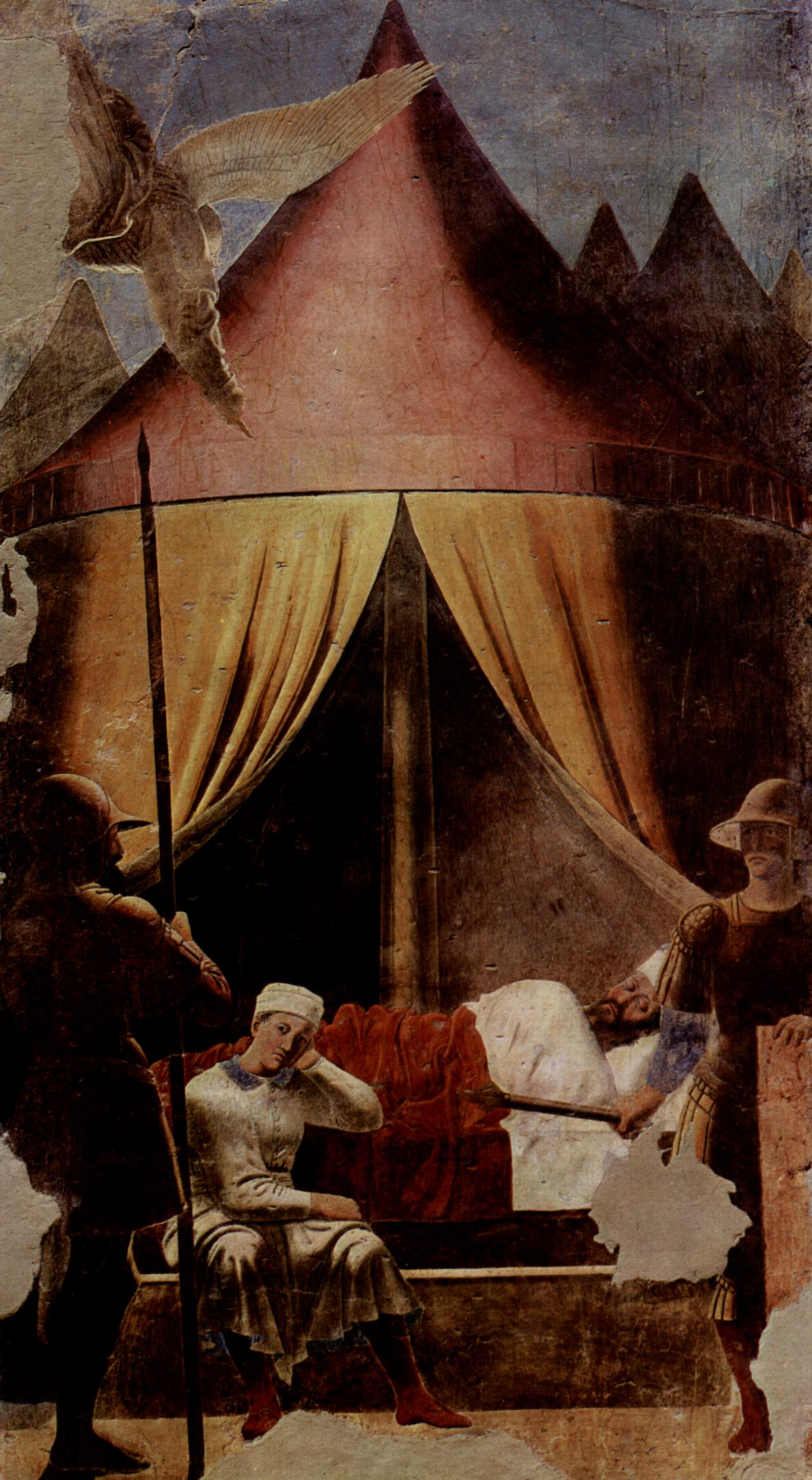 About this artwork →
Church life
- Christians suffered their last great Roman persecution. It began in AD 303 under Emperor Diocletian. Churches were torn down and Bibles were burned. P: Eusebius, Church History VIII.2 V1: Lactantius, Deaths of the Persecutors 12–13 V2: Catholic Encyclopedia, Diocletian. Christians who lost their lives for Christ are called martyrs (witnesses).
- Constantine, a Roman emperor, said that he saw a cross of light in the sky before a battle in AD 312. Eusebius says that Constantine told him this later. Lactantius says that a dream told Constantine to mark his soldiers’ shields with Christ’s sign. The two accounts differ. Teach both. P: Eusebius, Life of Constantine I.28–31 V1: Lactantius, Deaths of the Persecutors 44 V2: Catholic Encyclopedia, Constantine the Great.
- In AD 313, Emperors Constantine and Licinius agreed to give religious freedom to all, including Christians. P: Lactantius, Deaths of the Persecutors 48, imperial letter V1: Catholic Encyclopedia, Constantine the Great, religious policy V2: Eusebius, Church History X.5.4–5, the rulers’ letter. People call this policy the Edict of Milan.
- Cyril of Jerusalem taught people who were preparing for Baptism. His lectures explain Baptism as God’s gift that joins a believer to Christ. P: Cyril, Catechetical Lecture 3.1–4 V1: Catholic Encyclopedia, Cyril of Jerusalem, writings V2: Benedict XVI, Cyril of Jerusalem, 27 June 2007.
- Five more lectures, called the mystagogical lectures (teaching for the newly baptized), come down under Cyril’s name. The fourth of them (numbered 22 in this edition) says that the bread and wine in Communion are Christ’s body and blood. Scholars debate whether Cyril or his successor wrote these five lectures. P: Mystagogical Lecture 4, numbered 22 V1: Catholic Encyclopedia, Cyril of Jerusalem, writings V2: Benedict XVI, Cyril of Jerusalem, 27 June 2007.
- Helena, the mother of Constantine, went to Jerusalem. Church writers say that she found the cross of Christ. Constantine built a church over the tomb of Christ, and it was dedicated in AD 335 or 336. The story of the cross’s discovery rests on later writers. P: Eusebius, Life of Constantine III.25–40 V1: Socrates, Church History I.17 V2: Catholic Encyclopedia, Holy Sepulchre.
- Monks lived apart from society to pray and to fast. Pachomius (died about 346) gathered monks into shared communities in Egypt. P: Sozomen, Church History III.14 V1: Catholic Encyclopedia, Pachomius V2: Catholic Encyclopedia, Eastern Monasticism.
- Ulfilas (about 311–383) was a Gothic bishop. He made a Gothic alphabet and translated the Bible into Gothic. He sided with the Arian party (those who denied that the Son is fully God). P: Socrates, Church History IV.33 V1: Catholic Encyclopedia, Ulfilas V2: Encyclopaedia Britannica 1911, Ulfilas.
- Frumentius, a young man from Tyre who was held captive in the kingdom of Axum, brought the faith there. Athanasius made him its first bishop. Axum lay in today’s Ethiopia. P: Socrates, Church History I.19 V1: Catholic Encyclopedia, Abyssinia V2: Encyclopaedia Britannica 1911, Abyssinia.
Controversy and heresy
- Arianism: Arius, a pastor in Alexandria, taught that the Son of God was created and was not fully God. His bishop, Alexander, condemned this teaching in about AD 319. The dispute attacked the heart of Christ’s person and saving work. P: Socrates, Church History I.5 V1: Catholic Encyclopedia, Arianism V2: David Moser, Jesus’ Preexistence and Incarnation, §3.1.
- Nicaea rejected the claim that the Son came into existence or is a creature. The council added this rejection to its creed as an anathema (a formal condemnation). P: Nicene Creed and concluding anathemas, AD 325 V1: Catholic Encyclopedia, First Council of Nicaea V2: David Moser, Jesus’ Preexistence and Incarnation, §3.1.
- Donatism: Donatists said that a sacrament given by a bishop who had given up the Scriptures under persecution was not valid. They broke from the church over Caecilian, bishop of Carthage. The dispute asks what makes Baptism and the Lord’s Supper valid. P: Eusebius, Church History X.5, Constantine’s letters V1: Catholic Encyclopedia, Donatists V2: Encyclopaedia Britannica 1911, Donatists.
- Apollinarianism and Pneumatomachianism: Apollinaris said that Christ had no human mind. The Pneumatomachi (“Spirit fighters”) denied that the Holy Spirit is God. Constantinople I condemned both groups in 381. P: Constantinople I, Canon 1 V1: Catholic Encyclopedia, Apollinarianism V2: Catholic Encyclopedia, First Council of Constantinople.
- Julian, emperor from AD 361 to 363, grew up as a Christian. He left the faith and tried to bring back pagan worship. History calls him Julian the Apostate (one who leaves the faith). P: Socrates, Church History III.1 V1: Catholic Encyclopedia, Julian the Apostate V2: Ammianus Marcellinus, Roman History XXII.5.
Councils and major events
- Arles, AD 314: Emperor Constantine called Western bishops to Arles in Gaul. They sided with Caecilian against the Donatists. P: Eusebius, Church History X.5.21–24, Constantine’s letter to Chrestus V1: Catholic Encyclopedia, Donatists V2: Encyclopaedia Britannica 1911, Donatists.
- Lutheran classification: Received. On this point the synod’s verdict matches Augsburg Confession VIII. Sometimes an evil man gives a sacrament. That article says it still works by Christ’s promise. It also condemns the Donatists. Augsburg Confession VIII
- Nicaea I, AD 325: Constantine called the bishops together. The council’s creed confesses the Son as true God, begotten (born of the Father) rather than made, and consubstantial with the Father. Consubstantial means sharing the same divine essence. P: Creed of Nicaea V1: Catholic Encyclopedia, First Council of Nicaea, creed V2: David Moser, Jesus’ Preexistence and Incarnation, §3.1.
- Lutheran classification: Received. The Book of Concord prints the Nicene Creed, and Augsburg Confession I confesses the same teaching about the Son. Luther also defends the first four councils for guarding the faith about Christ. Nicene Creed in the Book of Concord, Luther, On the Councils and the Church
- Constantine’s call brought the bishops together at Nicaea. P: Eusebius, Life of Constantine III.6–12 V1: Catholic Encyclopedia, First Council of Nicaea, convocation V2: St Andrews Encyclopaedia of Theology, Conciliarity, §3.2.
- Nicaea also tried to settle the date of Easter, and it dealt with the Meletian split in Egypt. Meletius was an Egyptian bishop who broke away from his church. P: Socrates, Church History I.8–9 V1: Catholic Encyclopedia, Easter Controversy V2: Catholic Encyclopedia, First Council of Nicaea.
- Tyre, AD 335: a synod of bishops hostile to Nicaea deposed Athanasius on false charges. Emperor Constantine sent him into exile at Trier. P: Sozomen, Church History II.25 V1: Uta Heil, Athanasius of Alexandria, Life and Works V2: Catholic Encyclopedia, Arianism. The Catholic Encyclopedia gives the wrong year (325) for this synod.
- Lutheran classification: Spurious. The synod punished the chief defender of the Son’s full deity. The Nicene Creed in the Book of Concord holds the faith that Athanasius defended. Nicene Creed in the Book of Concord
- Serdica, about AD 343: Western and Eastern bishops met, and the Easterners left. The Western bishops cleared Athanasius, and their canons let a condemned bishop appeal to the bishop of Rome. Some date this meeting to 342 or 344. P: Council of Sardica, canons V1: Socrates, Church History II.20 V2: Catholic Encyclopedia, Arianism.
- Lutheran classification: Mixed. Clearing Athanasius protects the faith about Christ, and the Confessions agree. The canons that make Rome’s bishop a court of appeal clash with the Smalcald Articles. Those articles reject the pope’s claim to rule the church by divine right. Smalcald Articles II.IV
- Rimini and Seleucia, AD 359: two linked councils, one in the West and one in the East, accepted a creed. It called the Son “like the Father.” It dropped the word “substance.” Jerome later wrote that the world had woken up Arian. P: Athanasius, On the Councils 8–12 V1: Socrates, Church History II.37 V2: Catholic Encyclopedia, Arianism.
- Lutheran classification: Spurious. The Confessions reject its central doctrine. They confess with Nicaea that the Son is “very God of very God,” not merely “like” the Father. Nicene Creed in the Book of Concord
- Constantinople I, AD 381: the council reaffirmed Nicaea and defended the Holy Spirit’s full divinity. P: Constantinople I, creed and Canon 1 V1: Catholic Encyclopedia, First Council of Constantinople V2: St Andrews Encyclopaedia of Theology, Conciliarity, §3.3. Scholars are not sure how the creed took shape, but the church received it.
- Lutheran classification: Received. The Nicene Creed in the Book of Concord is the creed of this council, and Augsburg Confession I confesses the Trinity in its words. Augsburg Confession I
- African synods at Hippo (AD 393) and Carthage (AD 397) listed the books of Scripture. For the books written after Christ, their list matches ours. Their list for the first part of the Bible also includes Tobit, Judith, and Maccabees. P: Council of Carthage, canon list, as repeated in AD 419 V1: Catholic Encyclopedia, African Synods V2: Catholic Encyclopedia, article on the canon of the later books.
- Lutheran classification: Mixed. The Confessions accept the list of books written after Christ and take the Bible as the norm. The curriculum’s judgment is that Tobit, Judith, and Maccabees are not canonical. Luther’s Bible calls them useful reading and sets them apart. Formula of Concord, Rule and Norm
- In his AD 367 Festal Letter (his yearly Easter letter), Athanasius listed the same 27 books that fill the second half of our Bible today. P: Athanasius, Festal Letter 39, §5, with the heading that dates the letter to 367 V1: David Brakke, Canon Formation and Social Conflict in Fourth-Century Egypt V2: Carsten Peter Thiede, Christianity Today article on Athanasius’s 367 list.
- In AD 390, Ambrose, bishop of Milan, kept Emperor Theodosius from Communion after the emperor’s troops killed many people at Thessalonica. Theodosius did penance for about eight months and then came back. P: Theodoret, Church History V.17–18 V1: Catholic Encyclopedia, Theodosius I V2: Catholic Encyclopedia, Ambrose.
Major people
- Athanasius (bishop of Alexandria) argued that the divine Word truly took on human nature to save human beings. P: Athanasius, On the Incarnation 8–10 V1: David Moser, Jesus’ Preexistence and Incarnation, §4.2 V2: Benedict XVI, Athanasius, 20 June 2007.
- Eusebius of Caesarea wrote the first long history of the church. His Church History preserves letters and accounts from the first centuries. P: Eusebius, Church History I.1 V1: Catholic Encyclopedia, Eusebius of Caesarea V2: Encyclopaedia Britannica 1911, Eusebius of Caesarea.
- Cyril of Jerusalem taught the Christian creed together with preparation for Baptism and Communion. P: Cyril, Catechetical Lecture 4.2–3 and 32, creed and Baptism V1: Catholic Encyclopedia, Cyril of Jerusalem, writings V2: Benedict XVI, Cyril of Jerusalem, 27 June 2007.
- Basil of Caesarea defended the Holy Spirit’s full divinity. He taught that the Spirit is worshiped and glorified with the Father and the Son. P: Basil, On the Holy Spirit 1.3 and 18.45–47 V1: Catholic Encyclopedia, Basil, dogmatic writings V2: Benedict XVI, Basil, 4 July 2007.
- Gregory of Nazianzus held that Christ must have a human mind, since Christ saves the whole human person. He argued this against Apollinaris, who taught that Christ had no human mind. P: Gregory, Letter 101 to Cledonius, passage beginning “If anyone has put his trust in Him as a Man without a human mind” V1: Benedict XVI, Gregory, 22 August 2007 V2: David Moser, Jesus’ Preexistence and Incarnation, §3.2.
- Ambrose taught the newly baptized about Baptism and the Lord’s Supper in his book On the Mysteries. P: Ambrose, On the Mysteries 1.1-3 and 8-9 V1: James Loughlin, Catholic Encyclopedia, Ambrose, writings V2: J. H. Srawley, introduction to Thompson’s translation, §§I-II and VII, PDF pp. 6-8 and 24-25. Srawley’s introduction is commentary. It does not count as another ancient witness.
- Anthony of Egypt lived as a hermit in the desert. Athanasius wrote his Life of Anthony. P: Athanasius, Life of Anthony, prologue and §§3, 12–14 V1: Uta Heil, Athanasius of Alexandria, Life and Works V2: Encyclopaedia Britannica 1911, Anthony, Saint.
- John Chrysostom (about 347 to 407) was a famous preacher at Antioch and then bishop of Constantinople. He was chosen in 397 and ordained in 398. In a homily on Matthew, he teaches that the bread and cup of the Lord’s Supper are Christ’s body and blood. P: Chrysostom, Homily 82 on Matthew V1: Catholic Encyclopedia, John Chrysostom V2: Benedict XVI, John Chrysostom, 19 September 2007.
- Jerome revised the Latin Gospels against Greek manuscripts in about AD 383. His preface explains the work. P: Jerome, Preface to the Gospels, addressed to Damasus, paragraph beginning “Therefore, this present little preface” V1: International Standard Bible Encyclopedia, Vulgate V2: Crawford Howell Toy and Ira Maurice Price, Vulgate, Jewish Encyclopedia.
- Augustine of Hippo was a teacher of speech who turned to Christ in Milan in AD 386. He was baptized at Milan in 387. P: Augustine, Confessions VIII.12 and IX.6 V1: Catholic Encyclopedia, Augustine of Hippo V2: Benedict XVI, Augustine (1), 9 January 2008.
Wider world
- In AD 330, Constantine dedicated Constantinople, the enlarged city of Byzantium. P: Zosimus, New History II, paragraph beginning “Afterwards changing his purpose,” enlargement of Byzantium V1: Jona Lendering, Constantine’s City, dedication of 330 V2: Donald L. Wasson, Constantinople, AD 330 consecration and timeline. The historical accounts supply the dedication year.
- In AD 376, the Goths fled the Huns, who came from the east. They asked to cross the Danube River into Roman land, and Emperor Valens let them in. P: Ammianus Marcellinus, Roman History XXXI.3–4 V1: Socrates, Church History IV.34 V2: Donald L. Wasson, Battle of Adrianople, background.
- In AD 378, Gothic forces defeated the Roman army at Adrianople, where Emperor Valens died. P: Ammianus Marcellinus, Roman History XXXI.12.10 and XXXI.13.7–16 V1: Jona Lendering, Adrianople, AD 378 V2: Donald L. Wasson, Battle of Adrianople, battle and Valens’s death.
- Emperor Theodosius died in January 395. His sons Arcadius and Honorius succeeded him. P: Socrates, Church History V.26 V1: Catholic Encyclopedia, Theodosius I V2: World History Encyclopedia, Theodosius I.
Confessional Lutheran connection
- The curriculum’s confessional judgment is that this century’s main work was to defend Christ’s person. Nicaea (325) and Constantinople I (381) confessed Christ as true God, and the Lutheran Confessions say the same. Teaching prompt, Christology: Explain why the Son’s full deity matters for his saving work. Augsburg Confession I, Nicene Creed in the Book of Concord, Augsburg Confession III.
- Teaching prompt, Baptism: Compare Cyril’s lecture with the Lutheran Confessions. Separate Christ’s promise from the customs of the day. Cyril’s Baptism lecture, Augsburg Confession IX, Large Catechism on Baptism.
- Teaching prompt, Lord’s Supper: Compare Cyril and Chrysostom with the Confessions. Ask why the Son’s identity matters for the gift of his body and blood. Cyril’s Communion lecture, Chrysostom’s homily, Augsburg Confession X.
- Teaching prompt, the sacraments and the Donatists: Ask why a sacrament rests on Christ’s word and not on the minister’s worth. Augsburg Confession VIII, Donatist letters in Eusebius.
- Teaching comparison: Compare Anthony’s discipline with Augsburg Confession XXVII. Separate service to neighbors from works that claim to earn Christ’s forgiveness. Historical reading, Lutheran norm: Augsburg Confession XXVII.
- Teaching comparison: Use Athanasius’s list to discuss Scripture’s witness to Christ and the sacraments. Separate recognizing biblical books from creating their authority. Historical reading, Lutheran norm: Formula of Concord, Rule and Norm.
- Teaching comparison: Constantine’s rule changed how the church and the state relate. Compare it with Augsburg Confession XVI and XXVIII, which keep the two kinds of authority apart. Historical reading, Lutheran norm: Augsburg Confession XVI and XXVIII.