Week 20 · 20th century: AD 1901–2000
Artwork
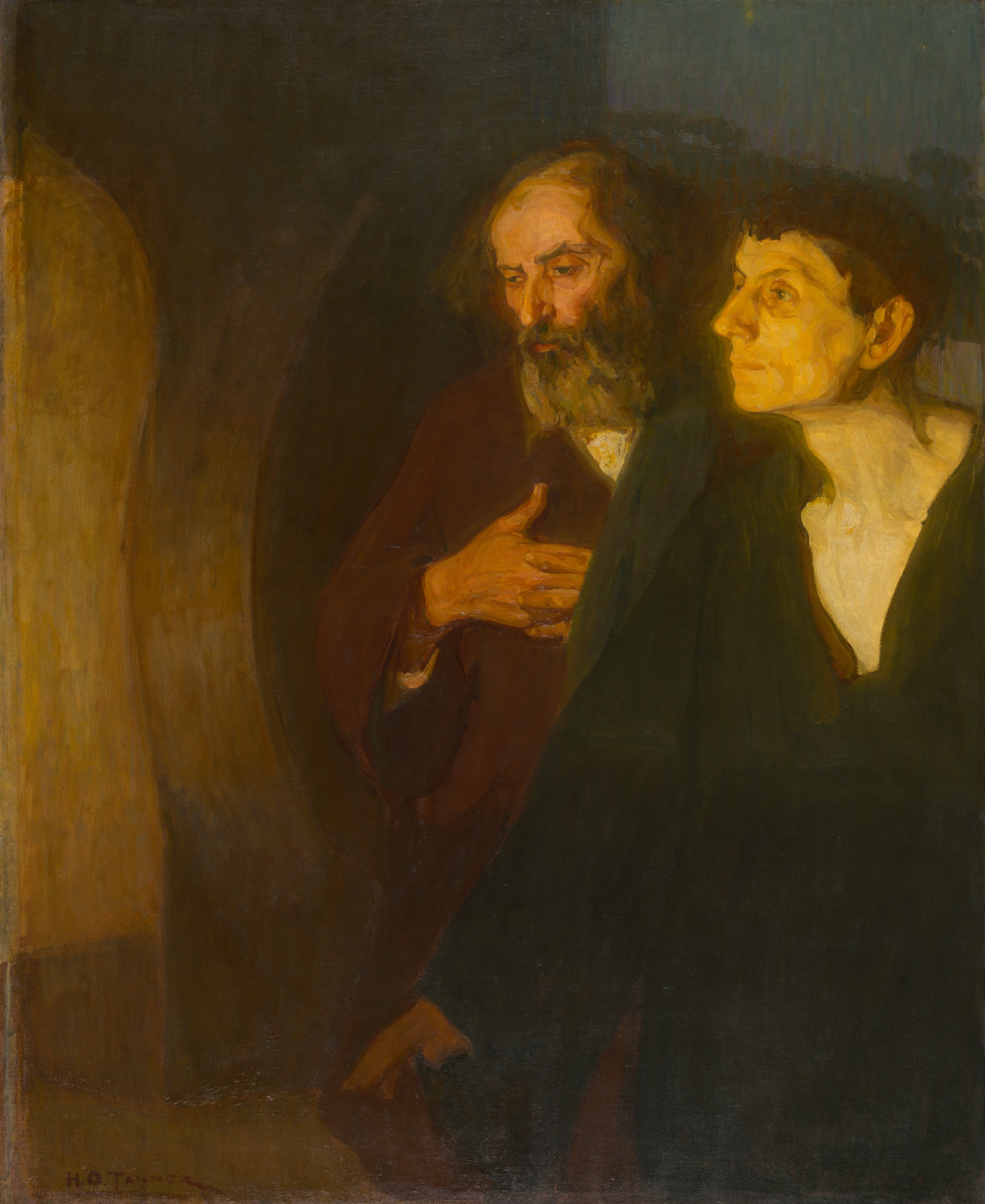
Artwork and image
- Title: The Two Disciples at the Tomb
- Artist: Henry Ossawa Tanner (American, 1859-1937)
- Date made: about 1906. The painting hung in the Art Institute of Chicago’s annual exhibition of American art from October 16 to November 29, 1906.
- Medium: Oil on canvas, 129.5 × 105.7 cm
- Current location: Art Institute of Chicago (Robert A. Waller Fund, 1906.300)
- Source page: Art Institute of Chicago, collection record
- License: CC0 1.0. The museum marks the work and the image as public domain.
What you see
Two men stand close together in a dark space. The older man has a gray beard. He looks down and presses one hand to his chest. The younger man is beside him and looks ahead and away from the viewer. A golden light falls on his face and neck. A pale arched opening on the left suggests the tomb. The picture has few colors. Browns and greens fill most of it, and the light draws the eye to the two faces. The artist signed it “H. O. Tanner” at the lower left.
Why it matters
Tanner was perhaps the best-known American painter of Bible scenes around 1900. He was the son of a leading minister of the African Methodist Episcopal Church. He left the United States for France in 1891, in part because racism limited his career at home. This painting shows Peter and John at the empty tomb on Easter morning (John 20:3-10). Tanner shows their inner reactions and does not paint a crowd or a vision of Christ. The Art Institute of Chicago bought the painting in 1906. That sale shows a Black artist working in Paris winning a major place in an American museum.
Christ and the sacraments
The painting is about Christ’s resurrection. The tomb is empty, and the light on John’s face points to the risen Lord. In Baptism, a person is joined to Christ’s death and resurrection (Romans 6). In the Lord’s Supper, the living Christ gives his own body and blood. Neither sacrament is shown here. The empty tomb is the reason both sacraments give life.
Teaching question
How does Christ’s resurrection give hope to a person who is baptized and who receives the Lord’s Supper? Read Small Catechism: Baptism and Small Catechism: the Supper. Then read Augsburg Confession III. A painting does not set doctrine. Judge what it shows by the Confessions.
Sources
- Art Institute of Chicago, “The Two Disciples at the Tomb” (collection record, description, exhibition history, and public-domain status)
- Smithsonian American Art Museum, Henry Ossawa Tanner (training at the Pennsylvania Academy, move to Paris in 1891, international reputation through religious paintings, father in the African Methodist Episcopal Church)