Week 21 · 21st century: AD 2001–October 5, 2026 (ongoing)
Artwork
No free-to-use painting from the 21st century fits this unit. The works below were made in the 16th century. They show Christ crucified and Baptism. Unit 16 features the Lord’s Supper panel of the Wittenberg altar. The 500th anniversary of the Reformation was marked in 2016 and 2017.
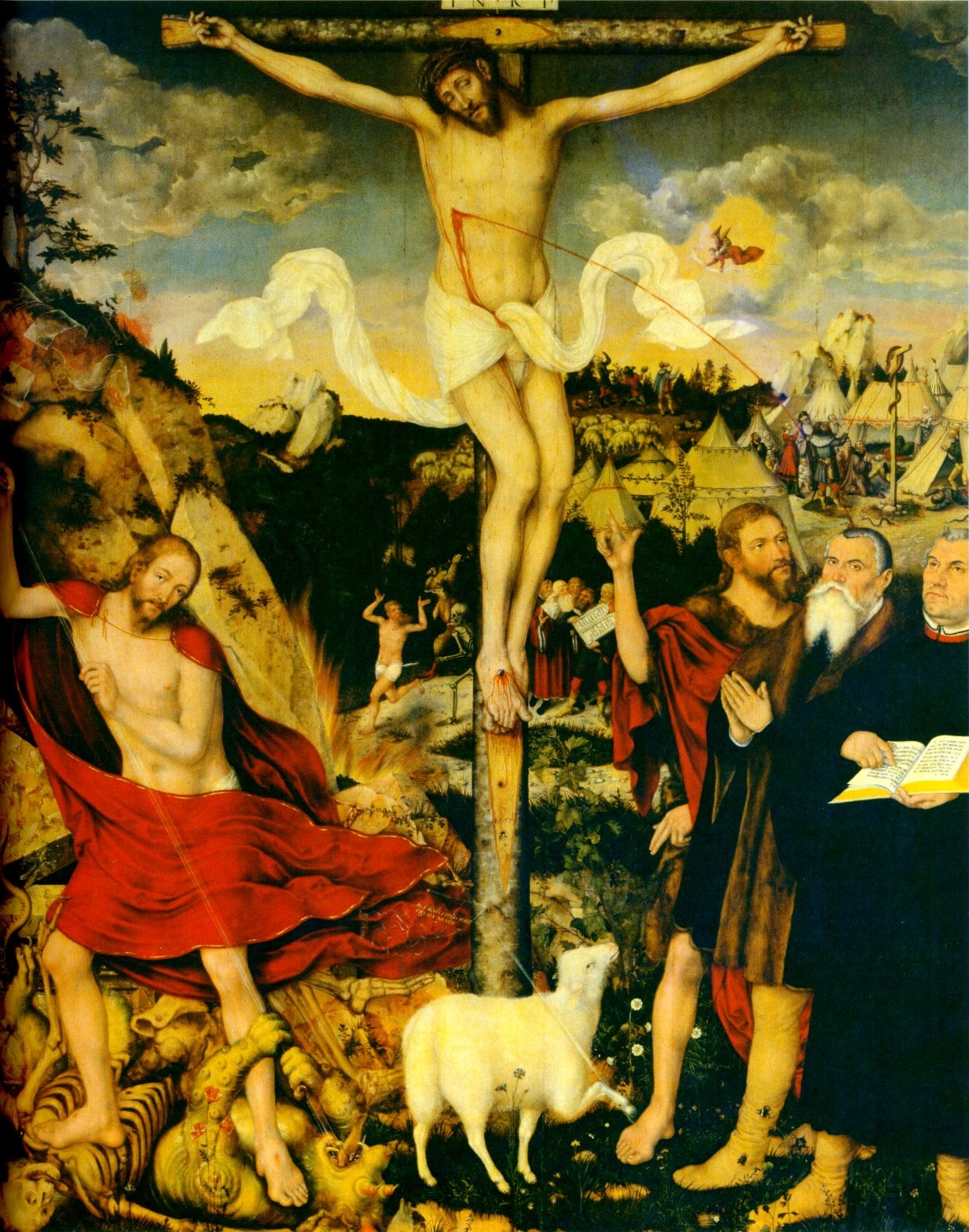
- Title: Christ on the Cross, central panel of the Weimar Altarpiece
- Artist: Lucas Cranach the Younger (long credited to his father, Lucas Cranach the Elder, who died in 1553)
- Date made: about 1555
- Medium: oil on lime wood
- Current location: Stadtkirche St. Peter und Paul (Town Church of Saints Peter and Paul), Weimar, Germany
- Source page: Wikimedia Commons, file page
- License: public domain (PD-Art, PD-old-100-expired), as recorded in the file page license section
- File: artwork.jpg (1233 by 1568 pixels, unchanged)


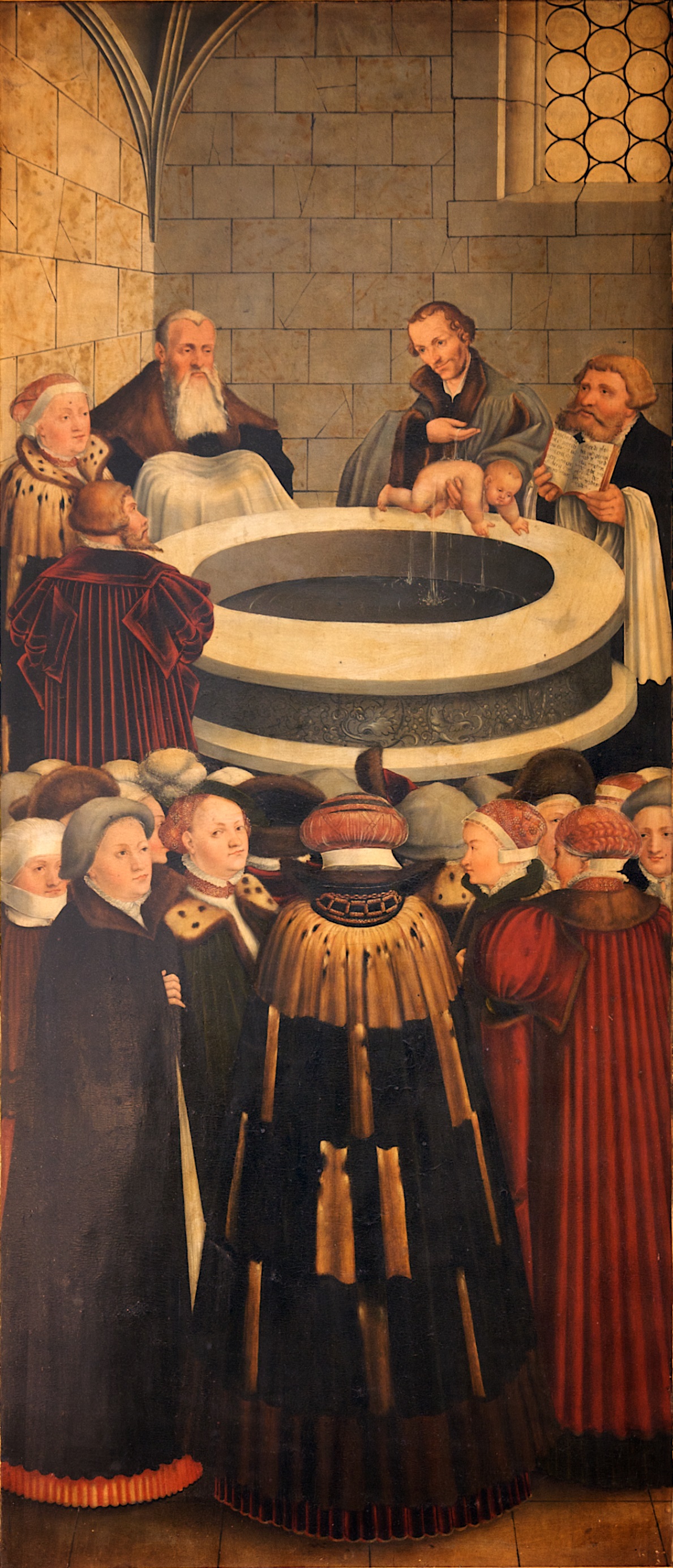
- Title: Baptism (Philipp Melanchthon baptizes an infant), left wing of the Wittenberg Altarpiece
- Artist: Lucas Cranach the Elder and Lucas Cranach the Younger, with their workshop
- Date made: 1547–1548
- Medium: oil on wood
- Current location: Stadt- und Pfarrkirche St. Marien, Wittenberg, Germany
- Source page: Wikimedia Commons, file page
- License: public domain (PD-Art, PD-old-100-expired), as recorded in the file page license section
- File: artwork-2.jpg (1189 by 2770 pixels, a higher-resolution photograph of the same panel)


What you see
The first painting shows Christ on the cross. On the left, the risen Christ stands on the devil and death. On the right, John the Baptist points to Christ. Luther stands beside him with an open Bible, next to the painter Cranach. Blood from Christ’s side falls on Cranach’s head. The second painting shows Philipp Melanchthon pouring water on a baby at a stone font while townspeople watch.
Why it matters
Cranach and his workshop painted for Luther’s own circle. The Wittenberg altar stands in the church where Luther preached. Its panels show Baptism, the Lord’s Supper, and absolution (the pastor’s declaration of forgiveness). Luther preaching fills the base of the altar. The Weimar altar was made as a memorial for John Frederick of Saxony. It explains Christ’s death as a picture of salvation. These paintings teach Lutheran doctrine in pictures. They are famous because they put the confession of Christ before the congregation. Their date is the 1540s and 1550s, not the 21st century. They fit this unit because today’s Lutheran debates about the Supper, ministry, and who Christ is return to the same teaching.
Christ and the sacraments
Both paintings aim at Christ. The Baptism panel shows water poured over an infant. The Weimar painting shows the crucified Christ, the risen Christ over death, and a verse about His blood cleansing from all sin. The Lutheran Confessions say that Baptism and the Supper give what Christ won on the cross.
Teaching question
What do Baptism and the Lord’s Supper give, according to the Small Catechism, and how do these paintings show those gifts? Use Small Catechism: Baptism and Small Catechism: the Sacrament of the Altar to answer.
Sources
- Lucas Cranach Digital Archive, Reformation altarpiece, central panel: the Last Supper with Luther as “Junker Jörg” among the apostles, the Baptism and Confession wings, and the Sermon predella.
- Gene Edward Veith, “Cranach Altarpiece,” Christian Culture (Fall 2021): Melanchthon baptizing an infant at left, the Last Supper in the middle, the Office of the Keys at right, and Luther preaching below.
- German History in Documents and Images, Martin Luther Preaching (1547): dates the Wittenberg altar to 1547–1548 and calls it the “Reformation altar.”
- German History in Documents and Images, Lucas Cranach the Younger, Christ on the Cross (c. 1555): gives the date, the attribution to the Younger, and the scene of Luther, Cranach, and the bleeding wound.
- Lucas Cranach Digital Archive, Weimar Altarpiece, central panel: describes Christ triumphing over death and the devil, and the figures at the right.