Week 10 · 10th century: AD 901–1000
Artwork
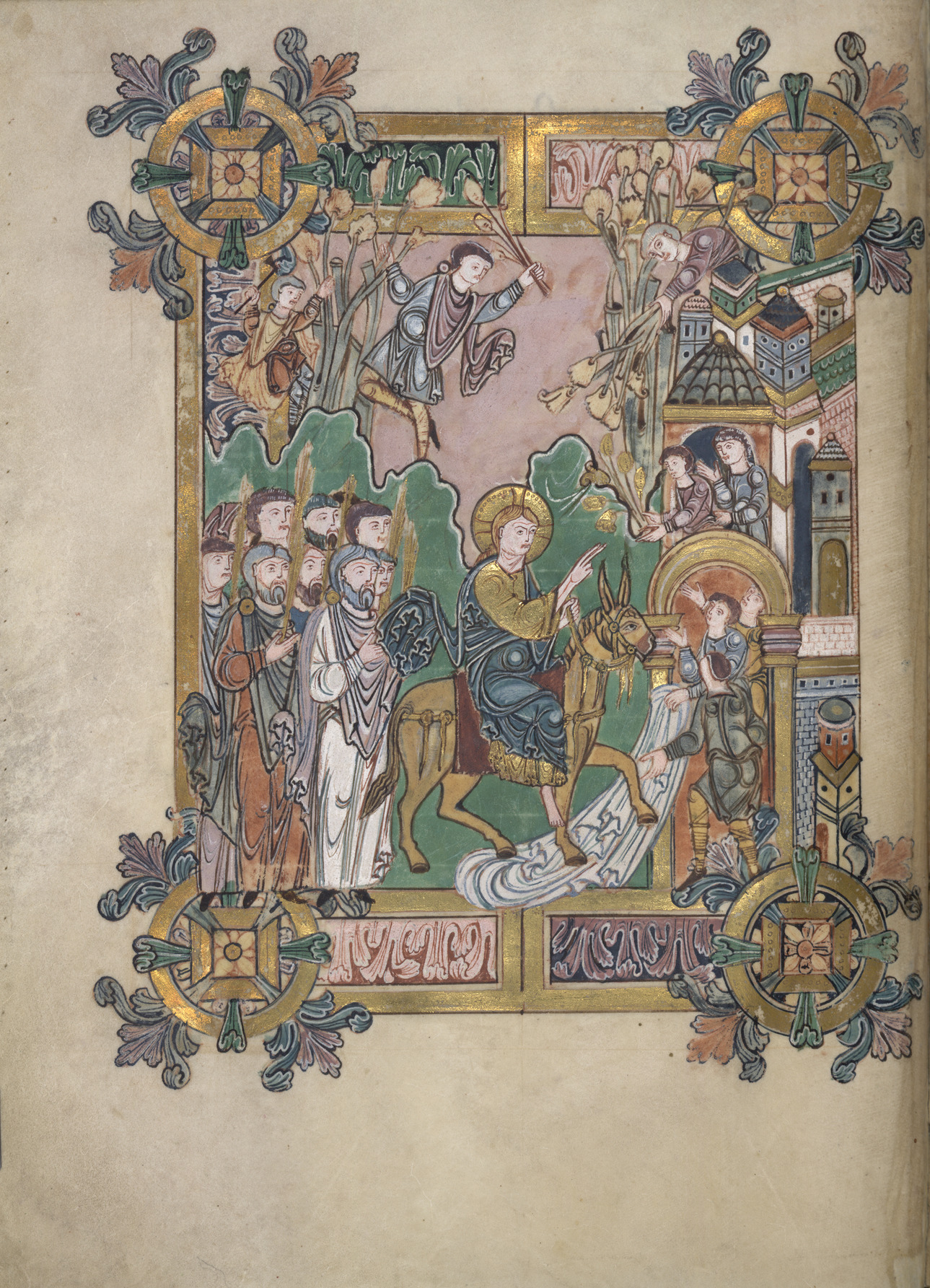
- Title: The Entry into Jerusalem (folio 45 verso)
- Artist: Unknown Winchester artist. The scribe was the monk Godeman.
- Date made: between 971 and 984 (the whole book dates between 963 and 984, probably the 970s)
- Medium: Paint, gold, and ink on parchment (an illuminated manuscript page)
- Current location: British Library, London, Add MS 49598
- Source page
- License: CC0 1.0 (the British Library provided the image, and the work is far past copyright)

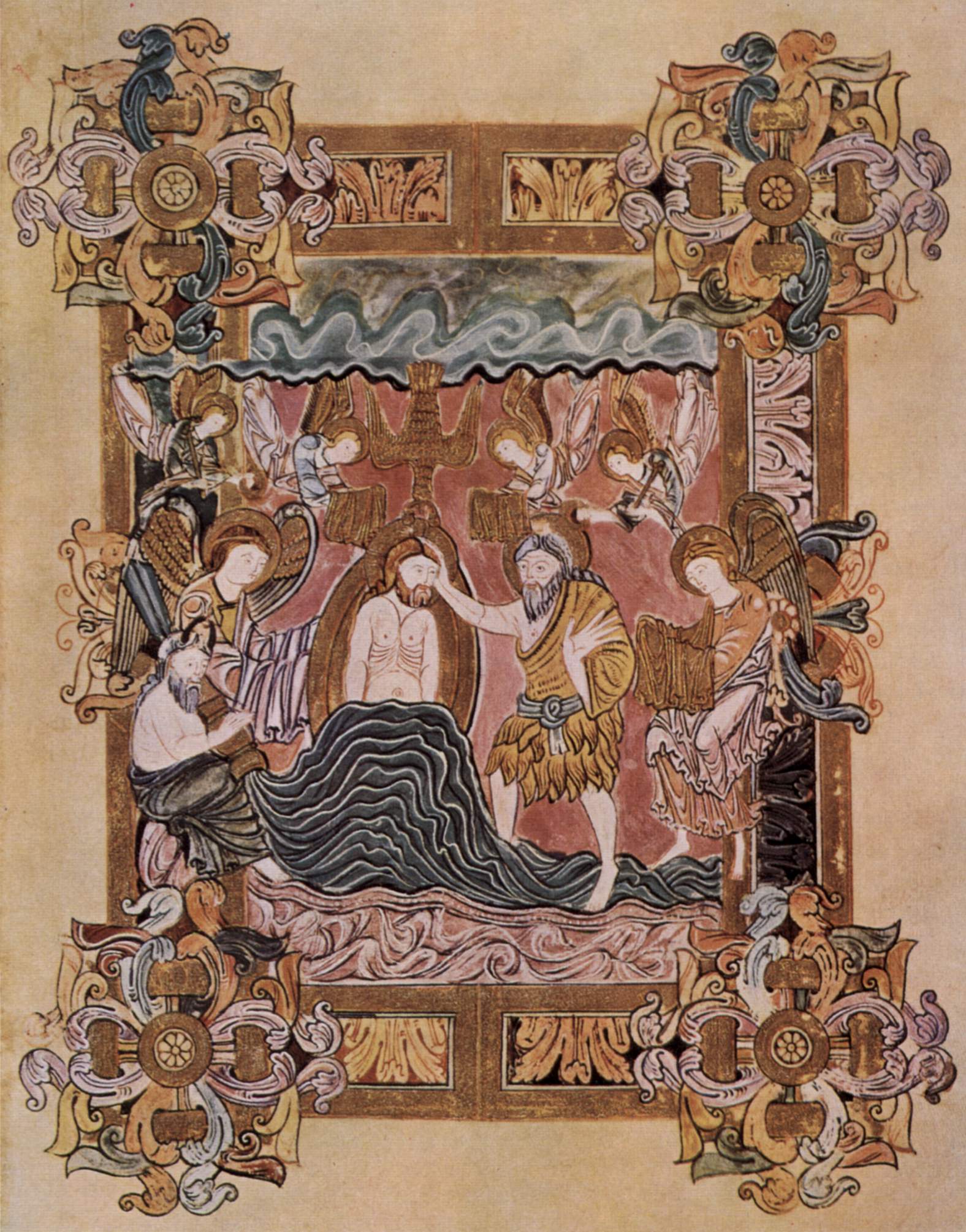
- Title: The Baptism of Christ (folio 25 recto)
- Artist: Unknown Winchester artist
- Date made: between 963 and 984, probably the 970s
- Medium: Paint, gold, and ink on parchment (an illuminated manuscript page)
- Current location: British Library, London, Add MS 49598
- Source page
- License: Public domain, as the Commons file page states (public domain mark).

What you see
On the first page, Christ rides a donkey toward the gate of Jerusalem. He wears a blue robe and a gold halo, and he lifts his hand in blessing. A crowd with palm branches follows him. Two youths spread a cloak under the donkey, and people lean from the walls and a tree to throw flowers. A gold frame with curling leaves surrounds the scene. On the second page, Christ stands in the Jordan River while John the Baptist pours water on his head. Angels stand on both sides, and a blue band of sky arches above them.
Why it matters
The Benedictional of St Æthelwold is the best known work of the Winchester school of English painting. Bishop Æthelwold of Winchester ordered it, and the monk Godeman wrote it. The book holds the blessings that the bishop spoke during Mass, and it has 28 full-page paintings. Its bright colors and thick leaf borders mark the Winchester style. The book was made while Æthelwold, King Edgar, and Dunstan worked to reform English monasteries. In 1911 it belonged to the Duke of Devonshire, and it now sits in the British Library.
Christ and the sacraments
The first page shows Christ entering Jerusalem to suffer and die for sinners. The book places it before the blessing for Palm Sunday. The second page shows Christ’s own Baptism, where the Father and the Spirit show him to be the Son of God. Lutherans link that scene to the Baptism Christ commands for all nations, in which he gives forgiveness and new life by water and his Word.
Teaching question
Why did the Baptism of Christ matter so much to the church, and how does Christ join his own Baptism to ours? Read Small Catechism, Baptism and Large Catechism, Baptism. A picture does not set doctrine for the church. Use the Confessions to test what the pictures teach.
Sources
- British Library catalogue, Add MS 49598: This record gives the date of 963 to 984, the scribe Godeman, and Æthelwold’s order. It counts 28 surviving full-page paintings, places the Entry into Jerusalem at f. 45v and the Baptism at f. 25r, and says the British Museum bought the book from the 11th Duke of Devonshire in 1957.
- Britannica (1911), Illuminated Manuscripts: This article calls the book the most elaborate tenth-century English illumination. It says Æthelwold, bishop from 963 to 984, directed the work, and that the Duke of Devonshire owned it.
- Catholic Encyclopedia, St. Ethelwold: This article gives Æthelwold’s dates and his monastic reform at Winchester.
- British Library record, Entry into Jerusalem, via Wikimedia Commons: This record says the scene prefaces the blessing for Palm Sunday.