Week 11 · Medieval
11th centuryAD 1001–1100
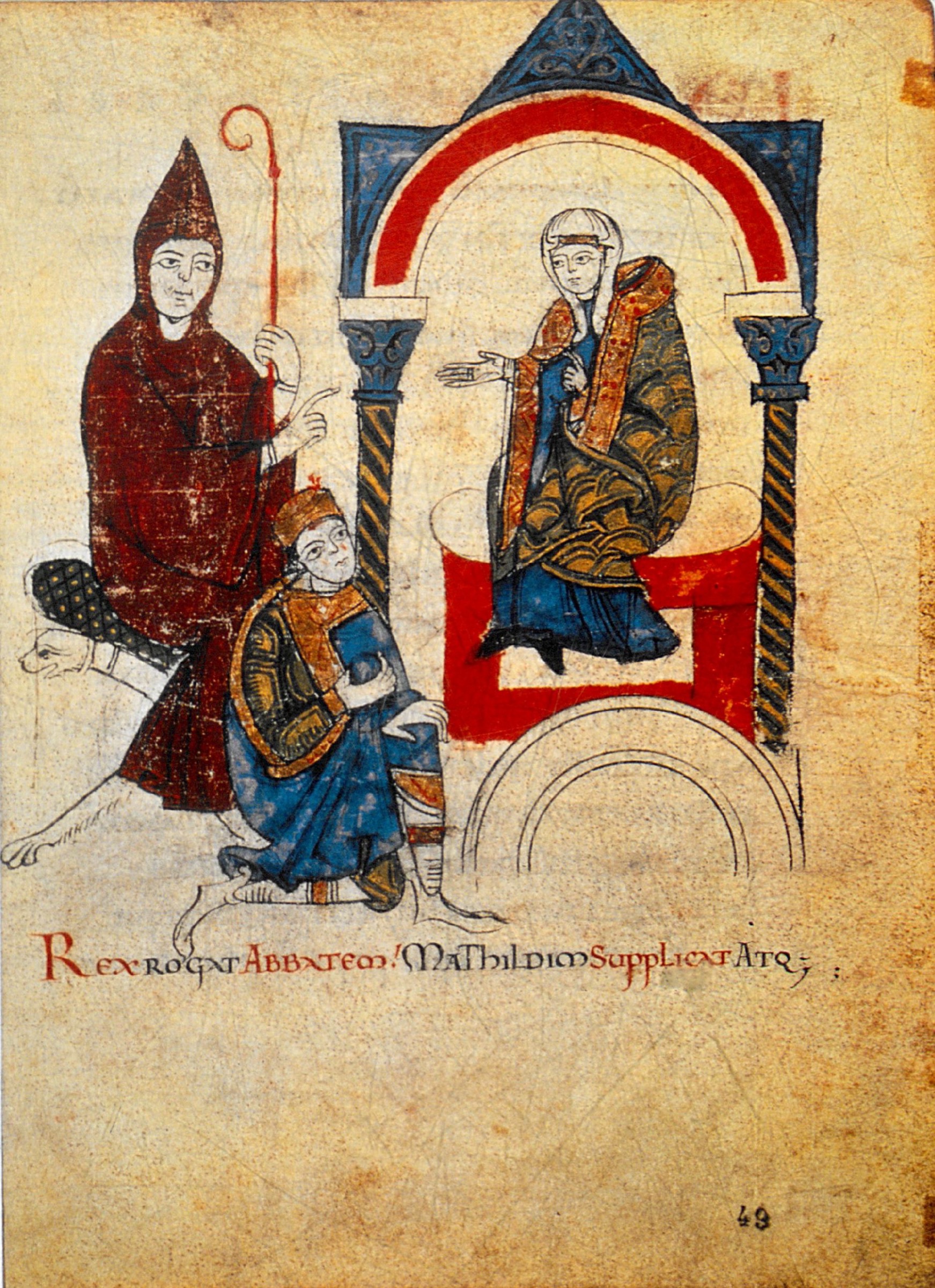 About this artwork →
Church life
- In March 1075, Pope Gregory VII’s official register recorded twenty-seven short statements of papal power, called the Dictatus papae (“the Pope’s dictates”). Number 12 says the pope can depose emperors. Number 27 says he can free subjects from their oath to unjust rulers. Historians debate whether Gregory wrote every line or whether he and his advisers drafted them. P: Dictatus papae, propositions 12 and 27 V1: Schaff V, §11 V2: Encyclopedia of Religion, Gregory VII, paragraph on the register and the twenty-seven statements.
- Tie to Christ (the curriculum’s confessional judgment): the Lutheran Confessions teach that Christ alone is the head of the Church. A claim that the pope rules kings as Christ’s earthly head goes beyond Scripture. Smalcald Articles II, IV.
- Gregory VII’s reform fought lay investiture (a ruler’s grant of a bishop’s or abbot’s office, with the ring and staff). A Roman synod in Lent 1075 forbade it. A decree of November 19, 1078 said that no clergyman is to receive a church from lay hands. P: Decree of 1078 V1: Catholic Encyclopedia, Gregory VII, 1075 synod V2: Schaff V, §15.
- Reformers also attacked simony (buying and selling church office). A Roman synod under Pope Nicholas II in 1060 ruled that bishops who bought office were to be deposed. It showed mercy to men ordained by them without payment. P: Roman Council of 1060, Denzinger §354 V1: Catholic Encyclopedia, Nicholas II, synod of 1059 on simoniacal ordinations V2: Schaff V, reform legislation against simony and clerical marriage.
- Teaching question: Compare the reform of clerical life with the use of civil power to enforce church judgments. P: Dictatus papae P: Augsburg Confession XXVIII, V: Schaff V, §§11 and 15.
Controversy and heresy
- Berengar of Tours (about 1000–1088) denied that the bread of the Lord’s Supper changes in substance. Lanfranc, abbot of Bec, opposed him. At a Roman council in 1059, Cardinal Humbert forced Berengar to accept an oath. It says the bread and wine are the true body and blood of Christ. It adds that priests’ hands handle and break them and the teeth of the faithful grind them. Berengar later attacked that oath. P: Berengar’s 1059 oath, quoted in Schaff IV, §128, note 729 V1: Catholic Encyclopedia, Berengarius, 1059 council V2: Encyclopedia.com, Berengar of Tours.
- At the Roman council of 1079, Berengar swore a new oath. It says the bread and wine on the altar are “substantially changed” into Christ’s true flesh and blood. This is the wording that later became the teaching of transubstantiation (the change of the bread’s and wine’s whole substance). Do not confuse it with the harsher 1059 wording. P: Oath, Denzinger §355 V1: Catholic Encyclopedia, Berengarius, 1079 profession V2: Schaff IV, §128, 1079 oath.
- In 1054 Eastern and Western leaders clashed over custom and doctrine. Patriarch Michael Cerularius’s side attacked the Latin use of unleavened bread in the Lord’s Supper. Cardinal Humbert’s bull charged the Greeks with cutting the “procession of the Holy Spirit from the Son” (the filioque) out of the creed. P: Humbert’s bull, English text V1: Anastos, §19, on azyma and the Filioque V2: Schaff IV, §71.
- On February 22, 1076, Gregory VII declared King Henry IV of Germany removed from his rule and freed all Christians from their oaths to him. This opened the Investiture Contest (the struggle over who has the right to appoint bishops). P: First deposition of Henry IV, 1076 V1: Catholic Encyclopedia, Gregory VII, 1076 citation of the emperor V2: Schaff V, §15.
- The Bogomils were a dualist sect. Dualists treat the material world as evil. The sect began in Bulgaria and became known in the Byzantine Empire late in the century. Anna Comnena says Emperor Alexios I searched them out and found a monk named Basil as their chief teacher. Our knowledge of their beliefs comes from opponents and from later sects. Those sources say they denied Christ’s divine birth and the worth of the sacraments. P: Anna Comnena, Alexiad, on the Bogomils, about 1110 V1: Britannica, Bogomils V2: Schaff IV, the Euchites and Bogomiles.
- Teaching question: Distinguish the confession of Christ’s real presence from a particular explanation of the change of the elements. P: Berengar’s 1079 oath P: Augsburg Confession X P: Formula of Concord, Solid Declaration VII.
Councils and major events
- Rome, Lateran, Easter 1059: Pope Nicholas II’s synod set a new rule for papal elections. The cardinal bishops choose first, then the other cardinals, and the rest of the clergy and people then consent. The same synod made Berengar sign Humbert’s oath. P: Decree of 1059 on papal elections V1: Catholic Encyclopedia, Nicholas II, Lateran synod of 1059 V2: Schaff V, passage on the law of Nicholas II. The Sacrament link: the oath (see Controversy) concerned Christ’s body and blood in the Lord’s Supper.
- Lutheran classification: Mixed. The oath rightly confesses that Christ’s true body and blood are present. It also adds a crude claim that teeth tear the body. The Confessions reject such “gross, carnal, Capernaitic” thinking. The election decree is church order, which the Confessions leave to human choice. Formula of Concord, Solid Declaration VII
- Rome, 1079: This local synod required Berengar’s profession of the Lord’s Supper. It marks a step toward the later definition of transubstantiation at Lateran IV (1215). P: Oath, Denzinger §355 V1: Catholic Encyclopedia, Berengarius, 1079 council V2: Schaff IV, §128.
- Lutheran classification: Mixed. The Confessions accept its statement that Christ’s true flesh and blood are given in the Supper. They reject its claim that the bread and wine are “substantially changed,” because the bread stays bread beside Christ’s body. Smalcald Articles III, VI, Formula of Concord, Solid Declaration VII
- Constantinople, 1054: On July 16, Humbert and the other legates (the pope’s envoys) laid a bull on the altar of Hagia Sophia. It condemned Michael Cerularius and named helpers. The Constantinopolitan response condemned the legates. Read both documents as attacks on named people. Do not call this exchange a decree against every Christian in the other church. P: Legatine sentence and Constantinopolitan response, English translations V1: Anastos, §19, paragraphs on the sentences and note 197 V2: Schaff IV, §71, July 1054 exchange.
- Lutheran classification: Not classified. These acts condemned named persons and fought over custom (unleavened bread) and rank, not a joint doctrinal decree. The Confessions say that unity does not need the same rites everywhere. Augsburg Confession VII
- Canossa, January 1077: King Henry IV crossed the Alps in winter and stood barefoot three days before the castle gate. Gregory VII then lifted the ban on him. Gregory’s own letter tells the story. P: Gregory VII’s letter to the German princes, January 28, 1077 V1: Catholic Encyclopedia, Gregory VII, Canossa V2: Schaff V, §16. Henry’s penance was real, but the fight over bishops went on after it.
- Clermont, 1095: Urban II called for military aid and a crusading expedition. Fulcher and other writers preserve different versions of his speech. Do not present any version as a word-for-word modern transcript. P: Clermont accounts, Fulcher V1: Schaff V, §49 V2: Britannica, Crusades, First Crusade.
- Lutheran classification: Not classified. The surviving accounts report a call to arms and church discipline, not a doctrinal definition. The Confessions hold that the Church’s power is the Word and sacraments, not the sword. Augsburg Confession XXVIII
- The First Crusade took Jerusalem on July 15, 1099. The crusading movement joined armed pilgrimage and religious aims. Discuss Urban’s own appeal beside the history of the expedition, and do not say every participant had the same motive. P: Siege and capture of Jerusalem, collected accounts V1: Schaff V, §49 and the fall of Jerusalem V2: Britannica, Crusades, First Crusade.
Major people
- Gregory VII (pope 1073–1085): His reform program ran through the Dictatus, the ban on lay investiture, and his clash with Henry IV. Read the Dictatus beside the contest over bishops and imperial power. Compare its claims with the Lutheran distinction between church and civil authority. P: Dictatus V1: Schaff V, §§11 and 15 V2: Catholic Encyclopedia, Gregory VII, investiture controversy.
- Henry IV, king of Germany: Gregory deposed him in 1076, and he came to Canossa in 1077 to seek release from the ban. P: Gregory VII’s letter on Canossa V1: Catholic Encyclopedia, Gregory VII V2: Schaff V, §16.
- Matilda, countess of Tuscany: Canossa was her castle. Donizo’s manuscript shows her with Abbot Hugh of Cluny as the king’s go-betweens. P: Donizo, Vita Mathildis, Vat. lat. 4922, fol. 49v V1: Schaff V, §16, on Canossa as Matilda’s fortress V2: Catholic Encyclopedia, Matilda of Canossa, on Matilda and Hugh of Cluny pleading for Henry IV.
- Anselm became archbishop of Canterbury in 1093. In Cur Deus Homo (“Why God Became Man”), he argues that only one who is both God and man can make the satisfaction that saves. Satisfaction means the payment owed for sin. P: Cur Deus Homo II.6–7 V1: Stanford Encyclopedia, Anselm, Atonement V2: Schaff V, §98. This is a claim about Anselm’s argument, not a statement that his full account equals Lutheran teaching.
- Urban II (pope 1088–1099): Study his call at Clermont through the differing surviving accounts. P: Clermont accounts V1: Catholic Encyclopedia, Urban II V2: Britannica, Crusades, First Crusade.
- Humbert of Silva Candida and Michael Cerularius: Humbert wrote the 1059 oath for Berengar and led the 1054 legation. Cerularius was Patriarch of Constantinople. Both were harsh and stubborn, and each side blamed the other for the break. P: Humbert’s bull and the response V1: Anastos, §19 V2: Schaff IV, §§71 and 128.

Wider world
- 1066: William of Normandy defeated Harold’s army at Hastings. P: Anglo-Saxon Chronicle, annal 1066 V1: English Heritage, Battle Abbey history V2: Royal Household, William biography.
- The Bayeux embroidery shows scenes from the Norman conquest of England in 1066. P: Bayeux Museum, artifact panorama and Battle of Hastings scenes V1: Catholic Encyclopedia, Bayeux, tapestry paragraph V2: Viking Ship Museum, The Bayeux Tapestry, opening description.
- 1085–1086: William ordered the survey of English landholding linked to Domesday Book. P: Anglo-Saxon Chronicle, annal 1085, survey paragraph V1: National Archives, Domesday collection introduction V2: Royal Household, Domesday survey paragraph.
Confessional Lutheran connection
- Lutheran teaching prompt, Christology: Compare Anselm’s God-man argument with Augsburg Confession III and Formula of Concord VIII. Keep the unity of Christ’s person central to the discussion of his saving work. The Bogomil denial of Christ’s divine birth gives a sharp contrast. P: Cur Deus Homo II.6–7 P: Augsburg Confession III P: Formula of Concord, Solid Declaration VIII.
- Lutheran teaching prompt, Baptism: Ask how Baptism delivers the benefit of Christ’s death without becoming a pledge of military or political allegiance. P: Augsburg Confession IX P: Large Catechism IV, Primary comparison: Clermont appeal.
- Lutheran teaching prompt, Lord’s Supper: Compare the incarnate Son’s real body and blood with the 1059 and 1079 oaths. Identify which claims the Lutheran confession accepts and which it rejects. P: Augsburg Confession X P: Smalcald Articles III, VI P: Formula of Concord, Solid Declaration VII, Primary comparison: Berengar’s 1079 oath.
- Lutheran teaching prompt, Church and state (the curriculum’s confessional judgment): Compare the Dictatus claim that the pope can depose emperors with another Lutheran teaching. Christ alone heads the Church, and the Church rules by the Word. P: Dictatus papae P: Augsburg Confession XXVIII P: Smalcald Articles II, IV P: Treatise on the Power and Primacy of the Pope.