Week 11 · 11th century: AD 1001–1100
Artwork
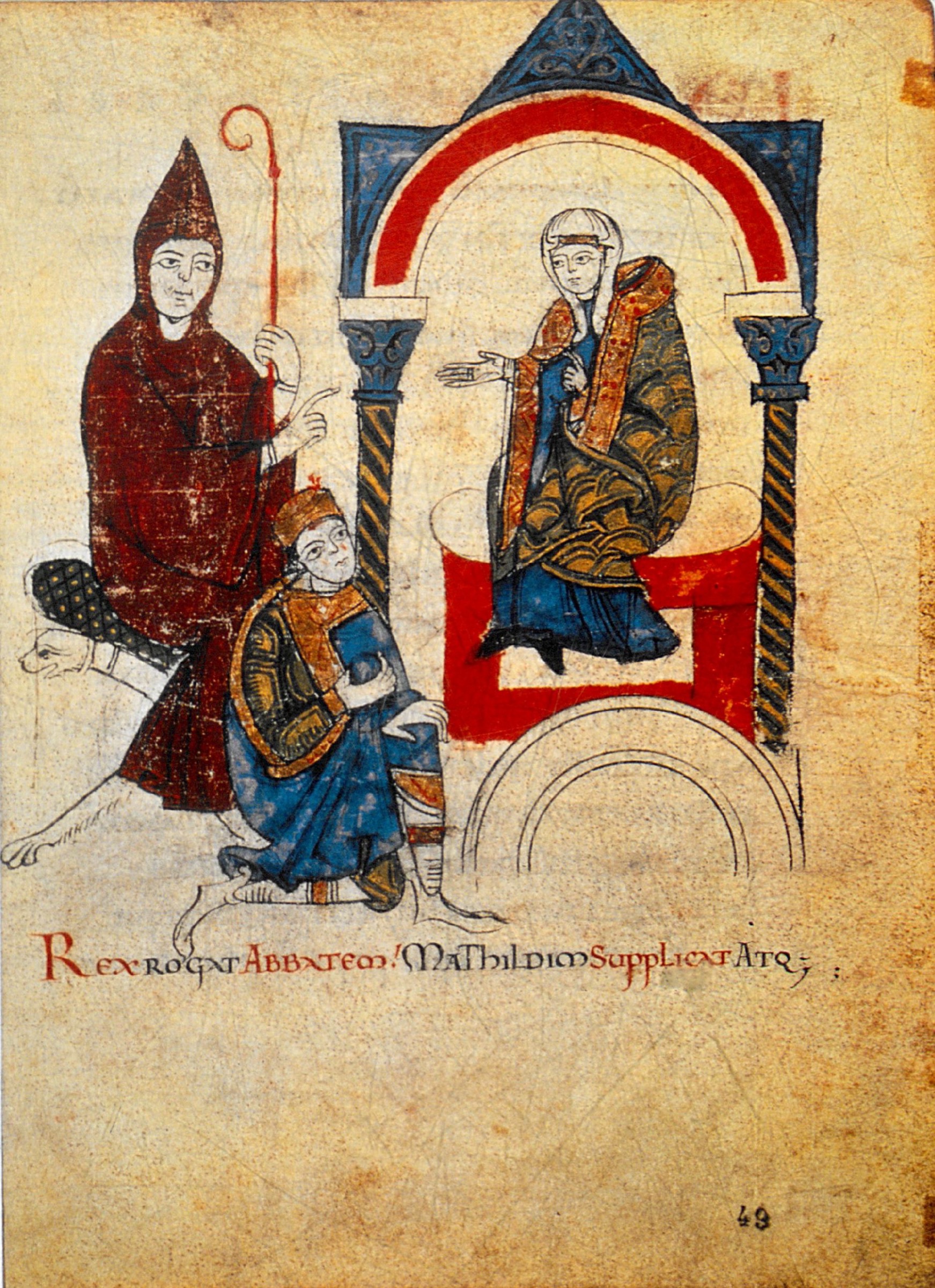
Artwork 1
- Title: Abbot Hugh of Cluny and Matilda of Tuscany as intercessors for Henry IV (caption: “Rex rogat abbatem, Mathildim supplicat atque”), from Donizo’s Vita Mathildis, fol. 49v
- Artist: Donizo, a monk of Canossa who wrote the book. The painter is not named.
- Date made: about 1115, some 38 years after the events at Canossa in January 1077
- Medium: illuminated manuscript page, pigments and ink on parchment
- Current location: Vatican Library, Vatican City, MS Vat. lat. 4922
- Source page (Wikimedia Commons)
- License: Public Domain Mark (artwork more than 70 years past its maker’s death)

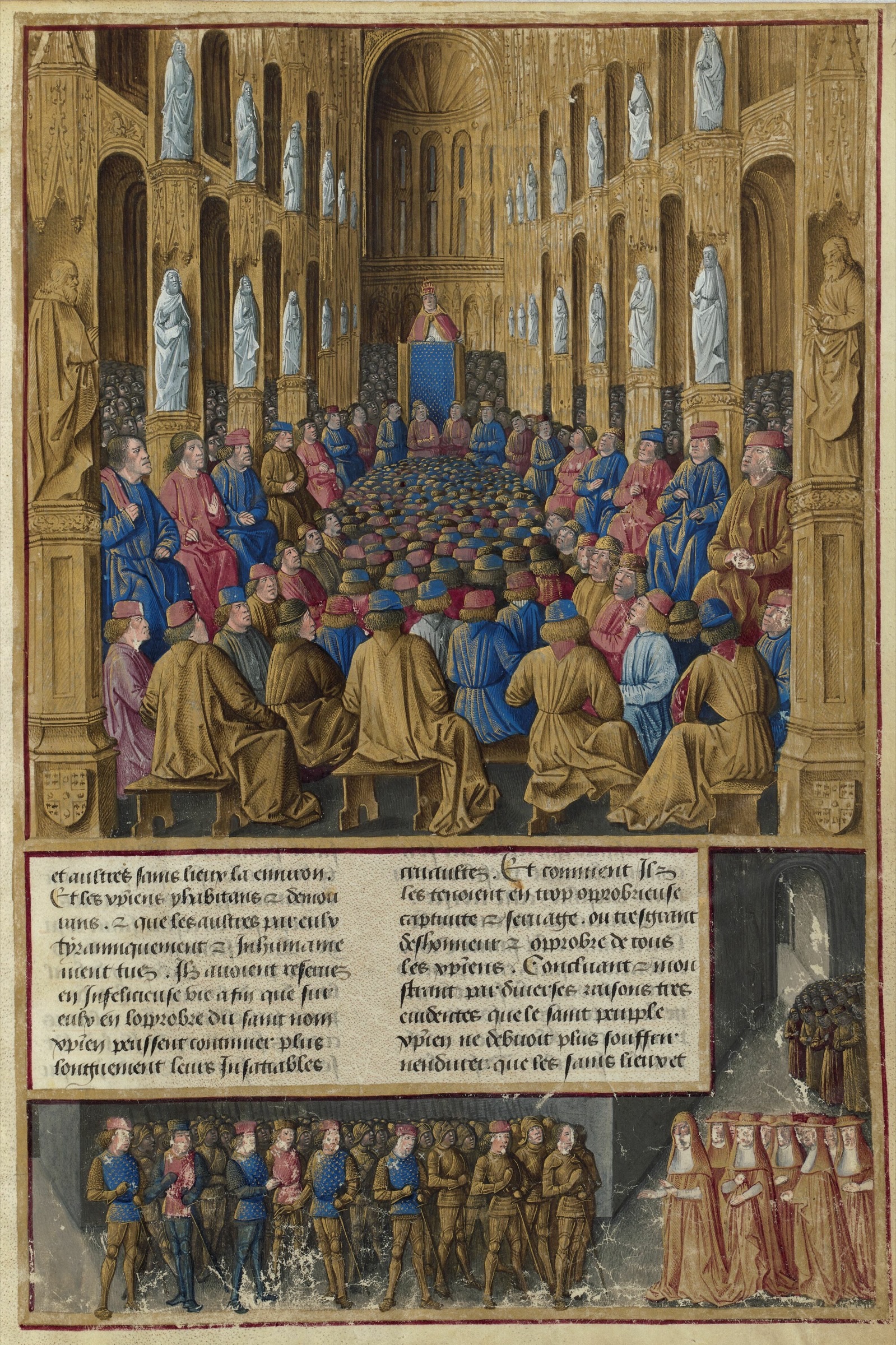
Artwork 2
- Title: Pope Urban II preaching at the Council of Clermont, from Les passages d’outremer, fol. 19r
- Artist: Jean Colombe, for a text by Sébastien Mamerot
- Date made: about 1474, nearly four hundred years after the council of November 1095
- Medium: illuminated manuscript miniature on parchment
- Current location: Bibliothèque nationale de France, Paris, MS Français 5594
- Source page (Wikimedia Commons)
- License: Public Domain Mark (artwork more than 70 years past its maker’s death)

What you see
The first page shows a king on his knees. Henry IV wears a small crown and a blue robe, and he looks up at a tall abbot in a red hooded habit. The abbot, Hugh of Cluny, holds a staff and points toward Matilda. She sits under an arch with blue and red decoration, and she stretches out one hand. A Latin line under the scene says the king asks the abbot, and begs Matilda. The second page shows a pope on a high throne in a Gothic church. Hundreds of bishops, nobles, and townspeople sit and listen. Armed men and cardinals stand in the lower panel.
Why it matters
Donizo wrote this book for Matilda, whose castle at Canossa was the setting for Henry IV’s penance in 1077. The artist drew the king small and humble, and Matilda and Hugh large and calm. That shows how Matilda’s own court told the story. Gregory VII’s letter and the later Church history both stress Henry’s penance, but the picture adds the two helpers who spoke for him. The second page comes from a much later book. It shows how fifteenth-century readers imagined Pope Urban II’s call for the First Crusade, in the dress and buildings of their own day. Neither page is a photograph of the past. Each shows how later people told the century’s two famous scenes. The Clermont scene belongs to 1095, and the Canossa scene to 1077.
Christ and the sacraments
Canossa was about absolution, the pardon that the Church speaks in Christ’s name, and about who holds the right to say it. The Lutheran Confessions teach that a pastor’s absolution is Christ’s own word and that Christ alone is the Church’s head. Clermont tied the pilgrim’s journey to forgiveness. The Confessions teach that Baptism and the Lord’s Supper give forgiveness by Christ’s promise, not by a journey or a battle.
Teaching question
A king kneels to win absolution. How does this picture compare with the Confessions’ teaching? They teach that Christ gives forgiveness freely through his Word and sacraments. Read Augsburg Confession XXVIII and Augsburg Confession XI.
Sources
- Gregory VII’s letter on the penance at Canossa, January 28, 1077 (Avalon Project)
- Schaff, History of the Christian Church V, §16: Canossa, 1077
- Finestre sull’Arte, The life of an extraordinary woman: Matilda of Canossa: Matilda’s castle at Canossa, the meeting of Henry IV and Gregory VII there in January 1077, Hugh of Cluny and Matilda as Henry’s intercessors, and the Vat. lat. 4922 miniature of them.
- Scrinium, The Life of Matilda of Canossa (Vatican Library, Vat. lat. 4922): Donizo as a monk of Canossa and later its abbot, and the manuscript, written about 1111 to 1115, with its miniatures.
- World History Encyclopedia, Council of Clermont: the council of 18 to 28 November 1095 and Urban II’s call for a crusade on 27 November.
- Ziereis Facsimiles, Les Passages d’Outremer: BnF Français 5594, text finished by Mamerot in April 1474, illuminated by Jean Colombe and his workshop, with a Clermont miniature.
- Bibliothèque nationale de France, catalogue record for the 1474 facsimile of Français 5594: the manuscript of 1474, illuminated by Jean Colombe.
- Urban II at Clermont, five versions of the speech (Fordham Sourcebook)