Week 17 · 17th century: AD 1601–1700
Artwork
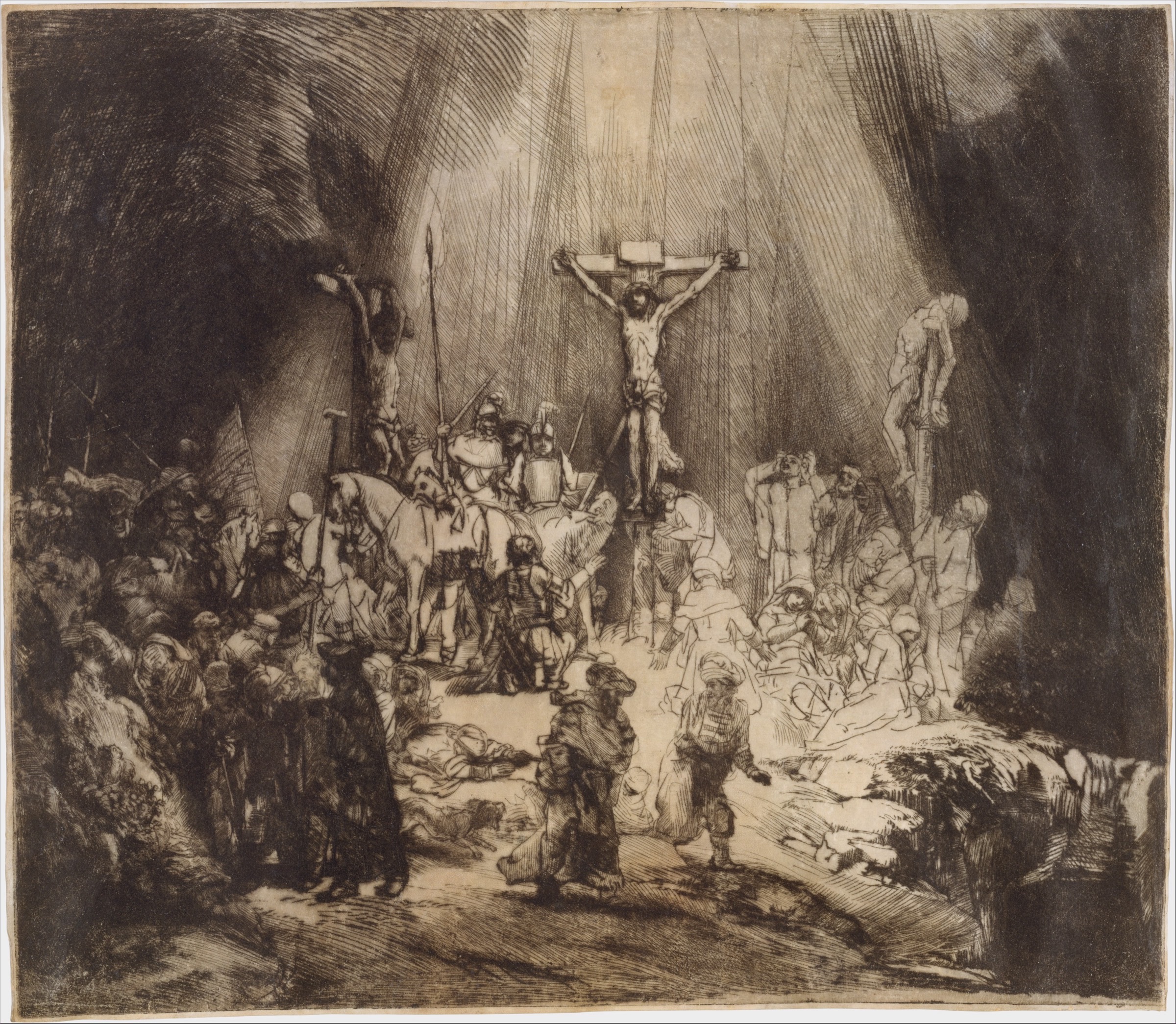
- Title: Christ Crucified between the Two Thieves: The Three Crosses
- Artist: Rembrandt van Rijn
- Date made: 1653
- Medium: etching with drypoint, first state of five, printed on vellum (per the museum record)
- Current location: The Metropolitan Museum of Art, New York, accession 41.1.31
- Source page
- License: CC0 1.0, Met Open Access
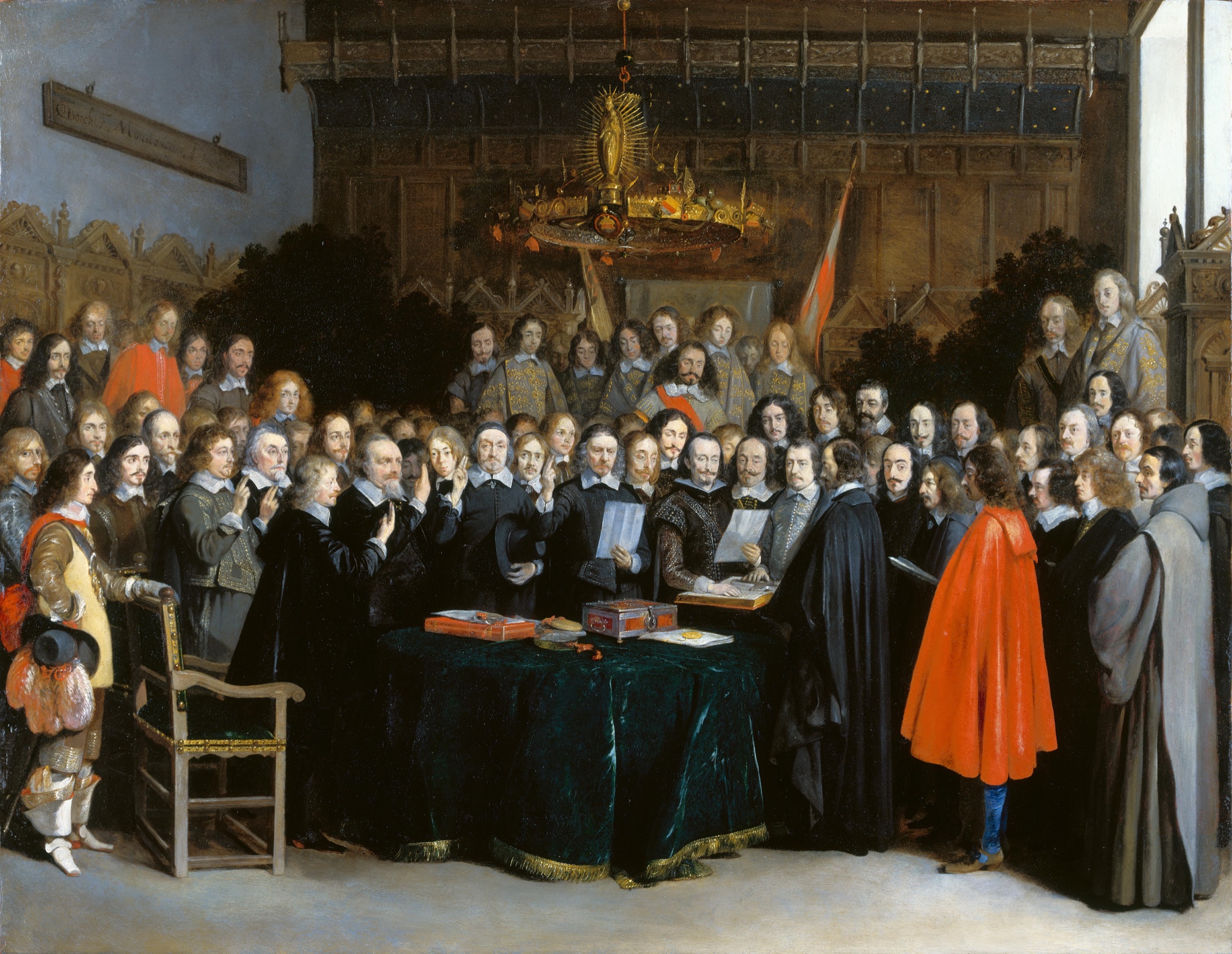
- Title: The Swearing of the Oath of Ratification of the Treaty of Münster
- Artist: Gerard ter Borch
- Date made: 1648
- Medium: oil on copper
- Current location: National Gallery, London (NG896), on long loan to the Rijksmuseum, Amsterdam
- Source page
- License: public domain, per the Wikimedia Commons file page

What you see
Rembrandt’s print shows Christ on the center cross. Beams of light fall on him from above. Two thieves hang on the crosses at the left and right, and both sit in deeper shadow. Below, soldiers, mourners, and onlookers crowd the hill. Some kneel, some turn away, and one rider looks up. The sky and the edges of the print are very dark.
Ter Borch’s painting shows about seventy men in a town hall. Spanish and Dutch delegates stand around a table with a dark green cloth. Some raise their fingers and swear an oath, while others hold papers. A Bible lies open on the table. A gilt figure hangs above the room.
Why it matters
Rembrandt made The Three Crosses in 1653, in the Dutch Republic, where the Reformed Church was the public church. It is one of the largest and most famous prints of the century. The Met’s impression is the first state of five. Rembrandt reworked the plate heavily in later states, so impressions differ. The dark and light areas draw the eye to Christ and make the viewer part of the crowd.
Ter Borch painted the Münster oath in 1648. It records the final step in the peace between Spain and the Dutch Republic, which ended the Eighty Years’ War. That peace was made in the same negotiations that produced the Peace of Westphalia. Ter Borch put himself in the crowd, at the left. The National Gallery calls it the first oil painting to show such a political event in a “factual” way.
Christ and the sacraments
Rembrandt’s print shows the cross where Christ won forgiveness for sinners. Baptism and the Lord’s Supper bring that forgiveness to individual people. Lutherans teach that Christ’s body given and blood shed on the cross are the same body and blood given in the Supper. Ter Borch’s painting has no direct tie to the sacraments. It shows a Bible on the table, but the treaty it records is political.
Teaching question
How do Christ’s own words link his death on the cross to the forgiveness given in Baptism and the Supper? Read Augsburg Confession III, Small Catechism: Baptism, and Small Catechism: the Sacrament of the Altar. A picture does not set doctrine. Use these texts to judge what the picture teaches.
Sources
- Metropolitan Museum of Art: Christ Crucified between the Two Thieves (The Three Crosses). Date, state, and collection data for the print.
- National Gallery of Art, Washington: Christ Crucified between Two Thieves (The Three Crosses). Another impression of the same print, which supports the composition and its date.
- Rijksmuseum: The Three Crosses. A third impression.
- National Gallery, London: The Ratification of the Treaty of Münster, NG896. Date, medium, location, the oath scene, and the self-portrait.
- Wikimedia Commons file page for the Ter Borch image. Image license and date.